GPR Service GmbH
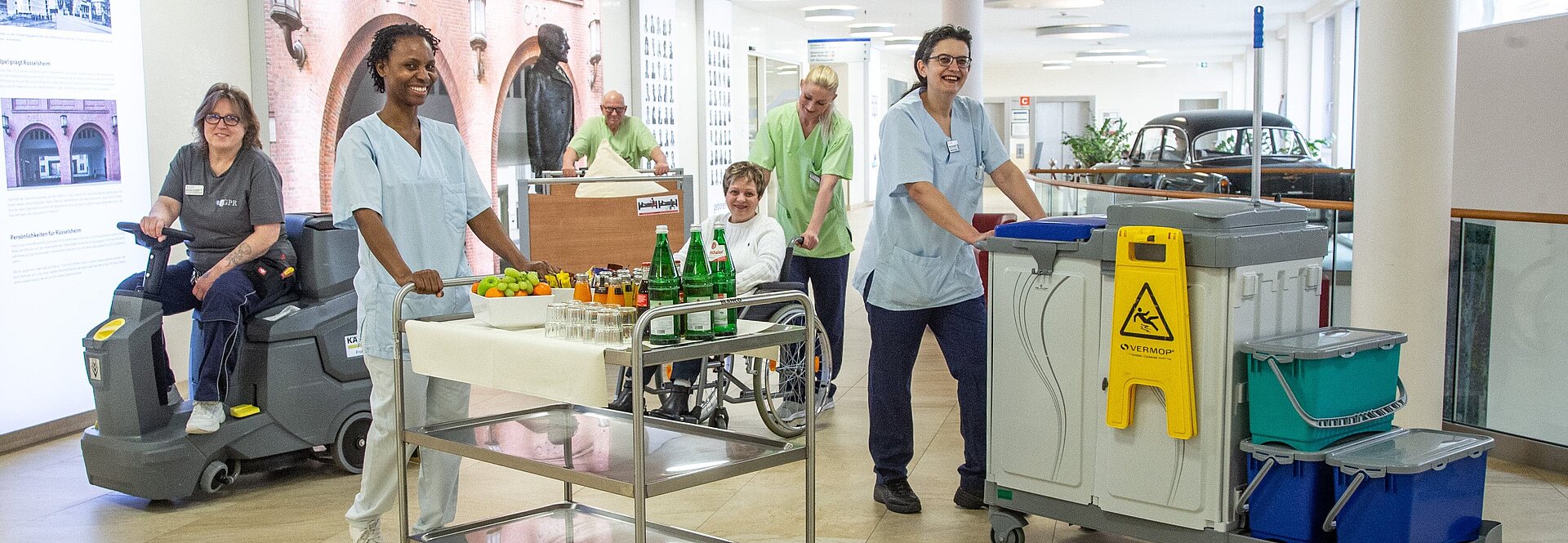
GPR Service GmbH is a wholly owned subsidiary of GPR Gesundheits- und Pflegezentrum Rüsselsheim gemeinnützige GmbH. Its primary mission is to provide support services for the Rüsselsheim Health and Care Center.
This involves providing high-quality, customer-oriented, and cost-effective services in the areas of traditional hotel services within the GPR Clinic and the GPR Senior Residence “Haus am Ostpark.” In close cooperation with the staff of the GPR Clinic and the GPR Senior Residence “Haus am Ostpark,” high-quality services are ensured across a wide range of sectors.
Information center
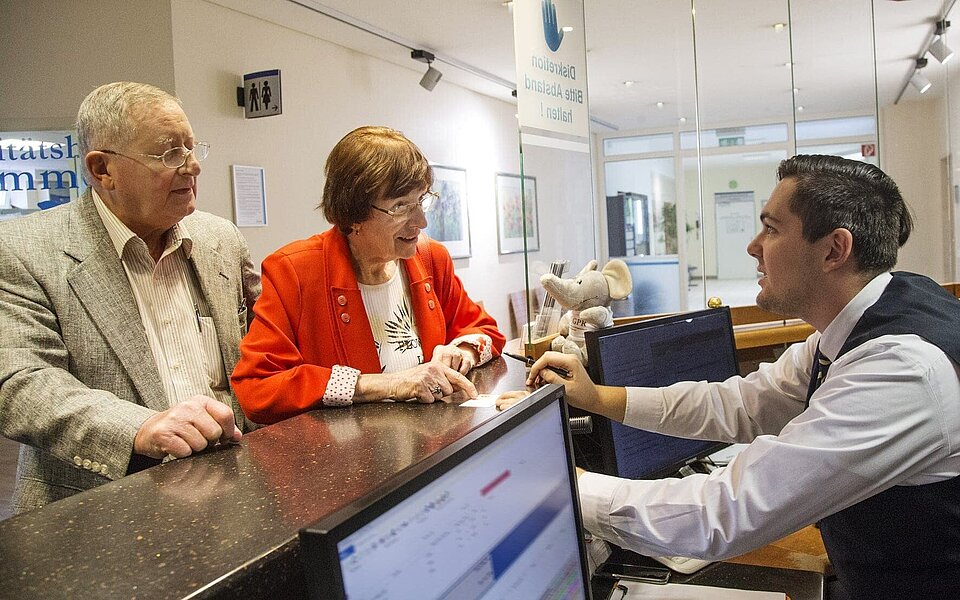
The Information Desk is the first point of contact at GPR Clinic. It is staffed 24 hours a day, 365 days a year. Here, we answer incoming calls and direct visitors and family members to the appropriate departments. Friendliness and helpfulness are second nature to us!
The Information Desk:
- is the first point of contact for visitors, patients, and callers
- connects you by phone
- issues patient phone cards
- provides you with hospital information brochures
- sells headphones for patient rooms
- sells the preventive care brochure “Advance Directives/Living Wills”
- sells all GPR promotional items, including hand cream, sparkling wine, the plush elephant “Paulchen Rüssel,” etc.
Clinic kitchen
Proper nutrition is crucial to patients’ recovery. That is why the staff in the GPR Clinic’s kitchen prepare meals according to nutritional principles. Meals are prepared in accordance with the guidelines of the German Nutrition Society. Provided their health and medical diagnosis permit, patients can choose from different daily menus.
The food service assistants ask patients Monday through Friday about their meal preferences for the following day.
They have a choice of three different lunch menus each day:
- Full diet
- Light full-course meal
- vegetarian meals
Unless patients have dietary restrictions due to required diets or medical tests, they may choose freely from the menu options. They also have the option to swap individual components within the menus. In the case of dietary restrictions, the basis for the lunch menu is always Menu 2, light full-course meals. In this case, their choice of components is limited.
For breakfast and dinner, the GPR Clinic offers patients either a selection of different options or the option to order à la carte and put together their own breakfast and dinner. The breakfast and dinner offerings have also been expanded to include a Mediterranean option as well as Turkish baked goods. The number of inpatients at the GPR Clinic is growing steadily, so that approximately 500 meals are prepared daily per meal for the patients alone.
Thus, the hospital kitchen produces 1,700 meals daily for the various departments. Each year, the hospital kitchen processes nearly 70,000 kg of meat and poultry, 13,500 kg of fish, 47,000 kg of fruits and vegetables, 40,000 liters of milk, and 366,000 rolls—to name just a few items. To ensure the necessary productivity and quality, the hospital kitchen is equipped with state-of-the-art equipment: This includes, among other things, the conveyor dishwasher, which cleans a good 1,700 plates, 2,000 cups, 1,700 sets of cutlery, 2,200 lids, 200 pieces of kitchenware (such as serving sets, baking sheets, and cooking utensils), 50 coffee pots, 400 glasses, and 1,700 trays. Additionally, there is a meal distribution conveyor that can be loaded from both sides, enabling meals to be portioned quickly and loaded into the meal distribution carts.
Before the meal distribution cart reaches the ward, it is heated or cooled at a docking station in the kitchen’s meal distribution center, depending on the meal, so that the food arrives at the patients at the correct temperature.
Clinic logistics
Hospital logistics is divided into patient logistics and internal logistics. Patient logistics focuses on the timely (just-in-time) transport of patients to service areas, such as the ECG and X-ray departments, and back again. 150,000 transports are carried out annually.
In addition to patient transports, these employees also transport materials such as blood, medical records, test results, etc. The internal logistics staff ensure the regular supply and disposal of materials for the wards and service areas. Their tasks include, for example, transporting food service carts, collecting recyclables, delivering pharmacy supplies, and much more. They thus serve as the central logistics hub for the GPR.
Bed preparation
After each patient change, the entire bed, including the nightstand, is disinfected. This also includes the wardrobe—unless it has already been unpacked—as well as the immediate patient area and the shelf in the bathroom.
During your stay, the nightstand is generally not cleaned further to ensure your privacy. If you would like the bedside table cleaned, please clear the surfaces—if possible—and ask the cleaning staff to do so when they are in your room. If your bed needs to be made fresh at any time during your stay, please contact the nursing staff. They will take care of everything else.
Garden maintenance and winter service
The Grounds Maintenance team is responsible for the outdoor areas of the GPR Clinic. In the summer, they ensure that the lawns are green and the flower beds are in bloom. During the winter months, they are responsible for clearing snow and spreading salt on the paths, so that you can arrive at our facility safely and comfortably, no matter the weather.
Cleaning
Cleaning
GPR Service GmbH is also responsible for maintaining cleanliness in our hospital. The following information is intended to provide you with a brief overview of the cleaning procedures in your patient room:
Cleaning Products/Chemicals
When using cleaning agents, we pay particular attention to high-quality equipment as well as environmentally friendly care, cleaning, and disinfectant products, which are applied in accordance with the required guidelines of the Robert Koch Institute.
Color-coding system
A 3-color system is used for cleaning patient rooms. This means that your cleaning staff uses cleaning cloths of different colors. Cleaning cloths, the corresponding buckets, and the cleaning chemicals are consistently labeled according to their function and application.
The color system is as follows:
- Blue – for all surfaces except hygiene and sanitary areas
- Yellow – for hygiene areas
- Red – for sanitary areas
For hygienic reasons, the cleaning cloths and mop covers are changed after each room to prevent the spread of germs. The fresh cleaning cloths are treated with the appropriate cleaning solution based on their intended use, so that one cloth is generally sufficient for all relevant surfaces in the room. The folding system of the cloths also helps ensure that multiple surfaces can be cleaned with a single cloth.
Cleaning Procedure
We use a modern team system for our cleaning staff. A team consists of four staff members, each assigned to a specific area. One staff member is responsible for the surfaces in the patient room, another for the surfaces in the restroom, and the other two are each responsible for the floor in the patient room and the floor in the restroom, respectively. By assigning fixed areas, we are able to maintain a consistently high standard of quality.
Training and quality control
Patient satisfaction is our top priority in providing our services. We ensure the quality of our work through ongoing training and instruction. In addition, staff members conduct daily spot checks in certain areas, including individual patient rooms. Our cleaning staff works daily to maintain a clean environment for you. If you are satisfied with the services provided, our cleaning staff would appreciate your praise.
For further information and suggestions regarding cleanliness at the hospital, a representative from Service GmbH is available by phone at the service speed dial number -1521. You can easily reach them from your patient phone.