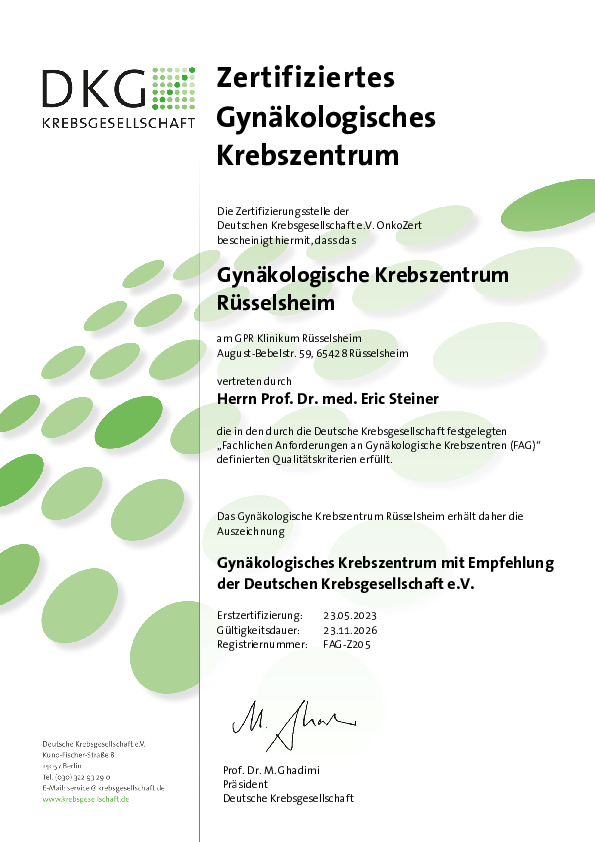
Gynecological Cancer Center Rüsselsheim
Everything from a single source - always at your side
Fortunately, a large proportion of the more than 27,000 women in Germany who are diagnosed with a malignant tumor of the female reproductive organs each year can be permanently cured through treatment (surgery, followed by chemotherapy or radiation if necessary). Thanks to significantly improved treatment options, life expectancy has also increased substantially even for patients for whom a complete cure is not possible.
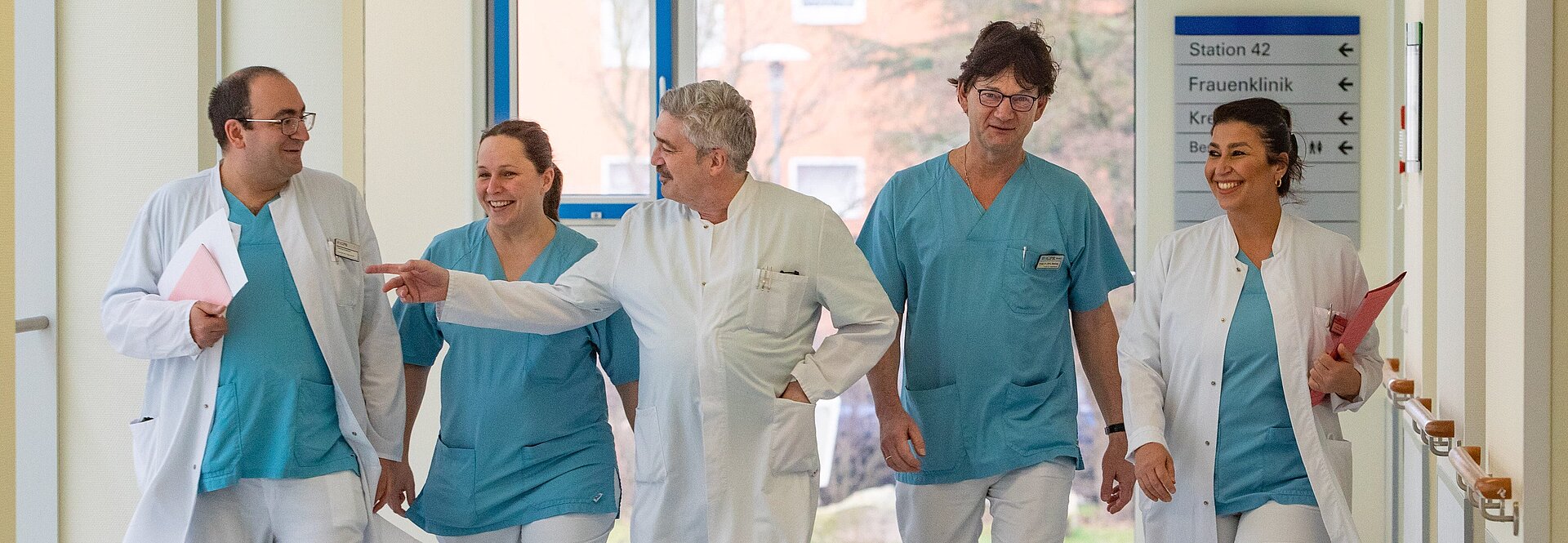
At the Gynecologic Cancer Center in Rüsselsheim, a specially trained team and experienced specialists in gynecologic oncology ensure that you receive the best possible treatment and care, tailored to your individual needs and based on the latest scientific findings.
The Gynecological Cancer Center is led by Professor Eric Steiner, MD, Chief of the Department of Gynecology. Since 2014, Professor Steiner has served as deputy coordinator of the “S3 Guideline on Endometrial Cancer” within the National Guidelines Program. The Oncology Guidelines Program of the Association of Scientific Medical Societies (AWMF), the German Cancer Society (DKG), and German Cancer Aid aims to jointly promote and support the development, updating, and implementation of scientifically sound and practical guidelines in oncology. He is also a co-author of the patient guideline on endometrial cancer. In addition to his role as chief physician, Professor Eric Steiner, MD, has been a permanent member of the Expert Council of the Uterus Organ Group within the Gynecologic Oncology Working Group of the German Cancer Society since 1999.
Focal points of treatment
The goal of the Gynecologic Cancer Center is to improve:
- Early detection
- Diagnosis
- Treatment
- Follow-up care
... for benign and malignant gynecological cancers.
At our Gynecologic Cancer Center, we care for women with ovarian, endometrial, and cervical cancer, as well as vulvar cancer and other rare malignant conditions. Our Cancer Center offers specialized consultation hours for initial evaluations and ongoing care. You can schedule an appointment for these consultation hours at the Gynecologic Cancer Center.
You can schedule an appointment for one of our consultation hours through the administrative office by calling 06142 88-1316 or by email: gynonko@gp-ruesselsheim.de.
The first contact usually takes place when your gynecologist has detected an unclear change in your genital organs or there is a suspicion of a malignant gynecological disease. Often, there are changes in the ovaries, the uterus, the vaginal opening, or the vagina itself whose exact nature is not immediately apparent. These may include cystic changes in the ovaries, bleeding, or thickening of the uterine lining in postmenopausal women, or skin changes in the vulvar area. We evaluate these changes during a specialized consultation. In addition to a gynecological examination with ultrasound and colposcopy, we offer computed tomography (CT) and high-resolution magnetic resonance imaging (3-Tesla MRI). In many cases where a referral is suspected, the changes turn out to be benign, and we are able to completely reassure our patients.
Clinical Presentations
The following types of cancer affecting the female reproductive organs are distinguished:
- Endometrial carcinoma (uterine cancer)
- Ovarian carcinoma (ovarian cancer)
- Vaginal carcinoma (vaginal cancer)
- Vulvar carcinoma (cancer of the vulva)
- Cervical cancer
They are primarily treated surgically—sometimes in combination with follow-up drug therapy.
Treatment
During a consultation, we discuss the various treatment options with prospective patients. In addition to interdisciplinary treatment plans, we also offer support in the areas of social services and nursing care.
Through interdisciplinary collaboration among specialists in the fields of
- Hematology-Oncology
- Radiology
- Radiotherapy, and
- Pathology
, appropriate therapies can be offered and optimally coordinated through collaboration.
Team
Prof. Dr. med. habil. Eric Steiner (Chief Physician, Gynecology Clinic)
Senior Physician Mario Vescia (Gynecology Clinic)
Senior Physician Dr. Adriana Haus (Women’s Clinic)
Senior Physician Asli Yilmaz (Department of Obstetrics and Gynecology)
Senior Physician Goerg Zohrabyan (Department of Obstetrics and Gynecology)
Prof. Dr. med. habil. Dimitri Flieger (Chief Physician of the First Department of Internal Medicine)
Dr. Lars Leupoldt (Chief Physician of the Department of General, Visceral, and Thoracic Surgery)
Dr. Oliver Bleiziffer (Senior Physician, Department of Plastic, Reconstructive, and Aesthetic Surgery)
Surgical Gynecology
Surgical Gynecology and Gynecologic Oncology offer the full range of established gynecological procedures for benign and malignant conditions, including numerous minimally invasive techniques. Today, virtually all surgeries for benign conditions can be performed via laparoscopy. Even in the early stages of malignant diseases, the necessary extensive procedures (including lymph node removal) can be performed via laparoscopy. In addition to better cosmetic results, the advantage is a significant reduction in hospital stay and recovery time. At the Gynecologic Cancer Center, we work closely with private medical practices. If a gynecologic cancer is diagnosed there, the patient can be referred to our clinic.
Tumor Board
Depending on the course of the surgery, the extent of the tumor, and your comorbidities, a team of experts develops a personalized treatment plan for you based on the latest scientific findings during our weekly tumor board meeting. In a dedicated molecular board, the genetic characteristics of the diseases are analyzed, and in consultation with your health insurance provider, the latest treatment options and our clinical trial center are made available to patients. For this, you have access to the combined expertise of physicians from the following specialties:
- Gynecology
- General/Visceral Surgery
- Plastic Surgery
- Radiology
- Nuclear Medicine
- Pathology
- Radiation Therapy
- Oncology
Psycho-oncological Counseling
Psycho-oncological care is an important component of cancer treatment and beyond, as a cancer diagnosis completely changes one’s life. Patients and their families are suddenly confronted with a host of questions and concerns; at times, they find themselves in a state of emotional and social upheaval.
Even during your inpatient stay, you have the opportunity to make initial contact with our qualified psycho-oncology staff, who will be happy to assist you with advice and support and/or provide you with contact information for therapists so that you can receive appropriate care on an outpatient basis as well.
This support, which we can provide promptly and tailored entirely to your personal needs and questions, paves the way for coming to terms with the illness—and for returning to an active life. Our goal is to accompany and support our patients during this difficult phase in accordance with our mission statement—a holistic view of the person.
As part of our treatment, we aim to work with you in a collaborative partnership to develop appropriate strategies, stand by your side, and walk the therapeutic path together.
Follow-up Treatment (AHB)
After cancer treatment, many patients take advantage of the option for so-called follow-up care (AHB), which is covered by health insurance. Our social services staff will advise you on this during your inpatient stay.
The Follow-Up Care Plan
The goal of cancer follow-up care is to detect any recurrence of the disease as early as possible. We also want to help you cope with or reduce the effects and side effects of the disease and treatment.
Specifically, the follow-up care plan includes…
…a follow-up consultation regarding the temporary and long-term effects of the disease and treatment, support services, psycho-oncological care, treatment options, sexuality and relationships, quality of life, etc.
as well as a physical examination, among other things, to detect a recurrence or accompanying symptoms of the disease. Both usually take place at your gynecologist’s office
… the gynecological examination: Regular, initially quarterly examinations, including a Pap smear, colposcopy, and/or vaginal ultrasound as needed. After 2–3 years, check-ups are conducted every six months for a period of 2 years, followed by annual check-ups (starting after a total of 5 years)
… treatment of side effects from primary therapy, particularly symptoms of hormonal deficiency (e.g., hot flashes, loss of elasticity/dryness of the vaginal mucosa), radiation-related side effects (affecting the bladder, ureter, and bowel), and lymphedema of the legs
… if necessary, ultrasound and X-ray examination of the breast (mammography). Routine diagnostic procedures, e.g., CT scans or laboratory tests, are not recommended as part of follow-up care.
The goals of follow-up care are…
… early detection of tumor recurrence in the genital area (local recurrence), new findings, or symptomatic metastases
… identification of (long-term) effects of the disease with the best possible symptom control The following
are only recommended if a recurrence is suspected…
- Chest X-ray
- Upper abdominal ultrasound
- Blood tests (tumor markers, etc.)
- Magnetic resonance imaging (MRI)
- Computed tomography (CT)
- Colonoscopy/gastroscopy
- PET-CT
- Bone scan
Management, team & treatment partners


Outpatient clinics & appointments
Make an appointment for a consultation:
Gynecologic Cancer Center
Appointment Scheduling
| Monday through Friday | 9:00 a.m. – 3:00 p.m. | Phone: 06142 88-1316 |
Dysplasia Clinic
Appointment scheduling
| Monday–Friday | 9:00 a.m. – 3:00 p.m. | Phone: 06142 88-1316 |
Private Consultation - Prof. Dr. med. Eric Steiner
Appointment Registration
| Friday | 8:00 a.m. – 12:00 p.m. | Phone: 06142 88-1316 |
Information for referrers
Working closely with private practice gynecologists, we offer you a standard of care in both diagnosis and treatment that meets national and international standards. The weekly interdisciplinary tumor conference and the weekly molecular tumor board ensure that you benefit from the expertise of a qualified team of specialists and receive treatment based on the latest scientific advancements.
Through our participation in the organ-specific groups of the German Gynecologic Oncology Association (AGO), we also ensure that treatment is always provided according to the latest scientific findings—the “state of the art.” Prof. Dr. Eric Steiner serves, among other roles, as the deputy national coordinator for the S3 guideline on endometrial cancer.
With Prof. Dr. Eric Steiner and Senior Attending Physician Mario Vescia, two specialists qualified in the treatment of pelvic tumors (“specializing in gynecologic oncology”) are available to you in Rüsselsheim. With the surgical expertise of two gynecologic oncologists, all modern surgical procedures can be successfully performed. For advanced tumors in the pelvis, extensive surgical procedures remain essential; these are planned and performed in collaboration with the departments of Visceral Surgery and Urology. In addition to modern drug therapies, surgical treatment plays a crucial role in the successful management of such aggressive diseases. We can guarantee the necessary knowledge and experience for this.
Please do not hesitate to contact us with any questions by phone (06142 88-1316) or by email atgynonko@gp-ruesselsheim.de. Upon request, we will also be happy to provide you with the Gynecologic Oncology hotline number, where Prof. Dr. Steiner can be reached directly at any time by colleagues in private practice.
Tumor Conference
Every Thursday at 3:30 p.m., an interdisciplinary tumor conference is held at our facility, during which, among other things, all patients with gynecological cancers are presented and discussed.
If patients whom you have referred or whom you are co-treating are to be discussed at the tumor conference, we would like to cordially invite you to attend.
Our weekly tumor board meeting takes place at GPR Klinikum every Thursday at 3:30 p.m.


Medical Director
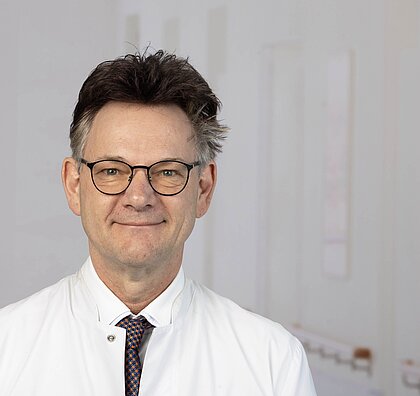
Prof. Dr. med. Eric Steiner
Tel.
06142 88-1316
Fax
06142 88-1223
frauenklinik@gp-ruesselsheim.de
Senior consultant
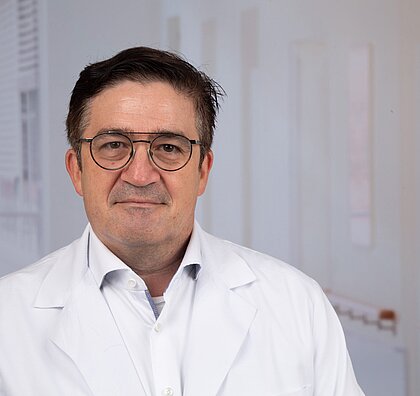
Mario Vescia
Tel.
06142 88-1316
Fax
06142 88-1223
vescia@gp-ruesselsheim.de

Interdisciplinary cooperation
- Plastic, Reconstructive,
and Cosmetic Surgery-> More Information - General, Visceral,
and Thoracic Surgery -> more information Department of Internal Medicine -> more information
Radiology -> more information
Radiation Therapy -> more information
Anesthesiology -> more information
Social Services -> more information
Transition to Home Care -> more information
PhysioFit -> more information
Case Management -> more information
Hospital Chaplaincy -> more information
GPR Academy -> more information
Self-Help Group -> more information
Hospice Care -> more information
Palliative Care -> more information