Institute of Radiology and Nuclear Medicine
Since April 1, 2023, Dr. Thilo Gerhards has served as Chief of the Department of Radiology and Nuclear Medicine at GPR Klinikum. In addition to his dual board certification in radiology and nuclear medicine, his appointment brings a new focus on neuroradiology to GPR Klinikum.
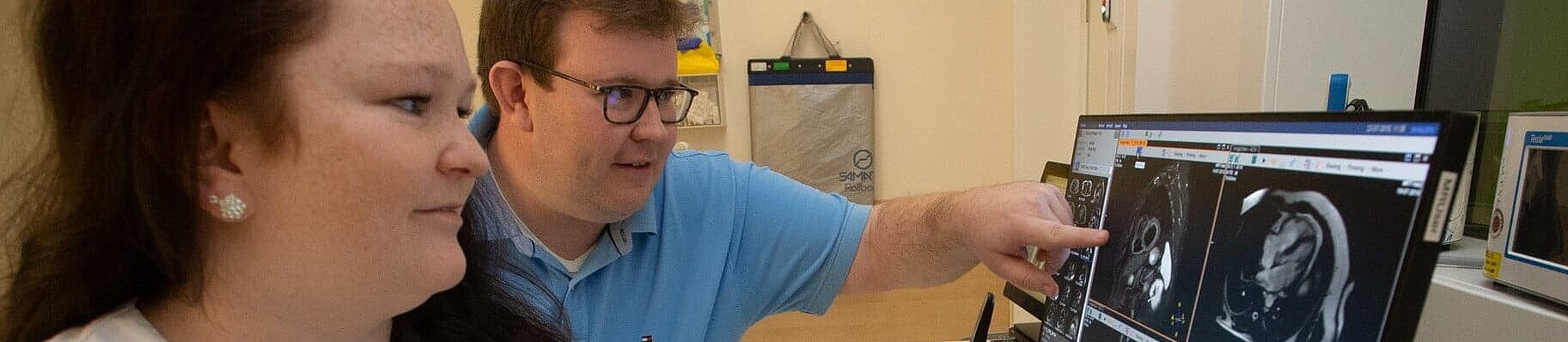
The Institute of Radiology and Nuclear Medicine is divided into the sub-specialties of X-ray diagnostics, large-scale imaging (CT/MRI), and nuclear medicine. As a central institute, it provides modern diagnostic imaging services to all medical clinics within the hospital.
In addition to caring for inpatients, a large proportion of examinations are performed on an outpatient basis, particularly in emergency care. Cross-sectional imaging techniques such as computed tomography (CT) and magnetic resonance imaging (MRI) form a particular focus of our work. Through so-called minimally invasive procedures, such as CT-guided biopsies and drainage placements, more complex and physically taxing surgical interventions can often be avoided. A Radiology Information System (RIS) and a Picture Archiving and Communication System (PACS) are available for image and findings communication within the hospital.
Examination options
Digital X-ray examinations:
skeletal imaging (e.g., to rule out fractures), chest X-rays, intravenous excretory urograms, and much more.
Digital fluoroscopy:
Contrast-enhanced imaging of the gastrointestinal tract, phlebography, myelography, and fistula imaging
Nuclear medicine examinations:
Skeletal scintigraphy, myocardial scintigraphy, thyroid scintigraphy, lung scintigraphy, and renal scintigraphy
Magnetic Resonance Imaging (MRI)
Examination of the skull (e.g., in cases of suspected stroke), the spine (e.g., in cases of suspected herniated disc or inflammation), and the joints (e.g., in cases of suspected ligament or meniscus damage)
Computed tomography (CT)
scans of the skull (e.g., in cases of suspected cerebral hemorrhage), the thorax (e.g., in cases of suspected pulmonary embolism), the abdomen (e.g., in cases of suspected intestinal disease), and the bones (e.g., following complicated fractures)

Magnetic resonance tomograph (MRT)
For MRI imaging, GPR Klinikum uses a fully digital 1.5-tesla MRI scanner. This allows for a wide range of specialized examinations, such as MRI imaging of blood vessels or MRI mammography, thereby avoiding invasive procedures or those involving radiation exposure.
The MRI scanner is characterized by significantly increased patient comfort. The device has a considerably larger tubular opening than a standard MRI scanner, resulting in significantly fewer examination interruptions, which were common with conventional MRI scanners due to the narrowness of the examination tunnel. In addition, the typical knocking noises associated with magnetic resonance imaging have been reduced compared to the previous generation of MRI scanners. Furthermore, a new multimedia system is available, which helps patients relax as much as possible during the examination.
In June 2025, magnetic resonance imaging (MRI) technology received a significant upgrade. The integration of Philips’ AI-based SmartSpeed solution has taken diagnostic imaging to a new level. SmartSpeed enables scan times to be accelerated by up to three times while simultaneously improving image resolution by up to 65 percent. These advancements help significantly shorten the duration of examinations for patients and increase diagnostic precision. The technology is compatible with 97 percent of clinical protocols and thus covers a wide range of examinations, including complex anatomical structures and modern contrast procedures.
State-of-the-art prostate diagnostics at GPR Klinikum
At GPR Klinikum Rüsselsheim and the affiliated Medical Center for Radiology and Nuclear Medicine, the MRI system was enhanced with an AI upgrade. This significantly improved image quality and established multiparametric prostate MRI with high diagnostic value.
Philips SmartSpeed AI improves imaging by specifically highlighting and precisely rendering relevant structures. At the same time, it reduces image artifacts such as motion blur. This leads to significantly higher resolution and improved image quality, particularly for small structures such as the prostate.
Under the leadership of Chief Physician Dr. Guido Platz, the Department of Urology, Pediatric Urology, and Oncological Urology has extensive experience with ultrasound-guided fusion biopsies and robotic prostatectomies. The optimized MRI system complements this offering and now also enables a complete radiological diagnosis of the prostate. Since multiparametric prostate MRI is not currently covered by statutory health insurance, it is billed as an IGeL service.
The goal is to offer patients diagnostics of the highest standard and to ensure a seamless transition to further examinations, including surgical treatment. When biopsies are performed independently in private practices, all image data and findings are provided in the appropriate format.
Information sheet on prostate MRI examination available for download

Computer tomograph (CT)
The Department of Radiology and Nuclear Medicine has two CT scanners. One of the machines has a particularly large opening, so it is primarily used to examine critically injured patients, as access to the patient is easier than with machines that have a narrower opening, allowing monitoring and procedures to be performed simultaneously while the patient is being prepared for the CT scan. Furthermore, the machine is used for CT-guided minimally invasive procedures.
The second CT scanner is a 128-slice device with significantly reduced radiation exposure. This machine is primarily used for examinations of blood vessels and the heart. This CT scanner offers additional diagnostic capabilities in cardiology; for specific clinical questions, it allows visualization of the coronary arteries without the need for catheterization.
Chief physician and team
The management of the Institute of Radiology and Nuclear Medicine

Chief Physician & Team


Head of medical-technical radiology assistants


Registration management

Appointments for people with statutory health insurance
Appointments at the MVZ Radiology and Nuclear Medicine Practice at GPR Clinic
Phone: 06142 88-4500
Fax: 06142 88-4505
Email: fa-radiologie@~@gp-ruesselsheim.de
X-ray Diagnostics
| Monday | 8:00 AM – 3:30 PM |
| Tuesday | 8:00 AM – 3:30 PM |
| Wednesday | 8:00 a.m. – 3:30 p.m. |
| Thursday | 8:00 a.m. – 3:30 p.m. |
| Friday | 8:00 a.m. – 3:30 p.m. |
CT and Nuclear Medicine
(By appointment only)
| Monday | 8:00 AM – 4:00 PM |
| Tuesday | 8:00 AM – 4:00 PM |
| Wednesday | 8:00 a.m. – 4:00 p.m. |
| Thursday | 8:00 AM – 4:00 PM |
| Friday | 8:00 AM – 4:00 PM |
MRI
(By appointment only)
| Monday | 8:00 AM – 4:00 PM |
| Tuesday | 8:00 AM – 7:00 PM |
| Wednesday | 8:00 AM – 7:00 PM |
| Thursday | 8:00 AM – 4:00 PM |
| Friday | 8:00 AM – 4:00 PM |
Your way to the Institute of Radiology and Nuclear Medicine
The Department of Radiology and Nuclear Medicine is located on Level 1 (basement) of the GPR Clinic.
When you enter the hospital’s main entrance, turn right and follow the hallway (about 20 meters), past Café Stolz, to Elevator Lobby A. Take the elevator down to Level 1 or use the stairs. On Level 1, follow the hallway (approx. 20 meters) until you see the neon sign “Radiology.” Then turn right and simply follow the blue line on the floor, which will lead you directly to the registration desk.


GPR NAVI App
GPR NAVI App
The GPR Clinic is now offering the free GPR Navi app. This innovative app makes it easy to navigate the clinic. The free app is available for Android and Apple smartphones on the Google Play Store and the Apple App Store and promises easy navigation within the GPR Clinic. To use it, simply download the GPR Navi app to your smartphone, and the app will reliably guide you to your destination within the GPR Clinic. The app covers not only the main building but also the medical care centers (MVZs) and practices on the grounds.
Here’s how GPR Navi works:
1. Enter the search term “GPR NAVI” into the app’s search function.
2. Select your destination from the results displayed.
3. The GPR Navi guides users through the GPR Clinic in real time on their smartphone.

Appointments for privately insured persons
Department of Radiology and Nuclear Medicine, GPR Clinic
(X-ray diagnostics, CT, MRI, and nuclear medicine)
Private appointments: Monday through Friday by appointment
Phone: 06142 88-1320
Fax: 06142 88-1855
Email: fa-radiologie@~@gp-ruesselsheim.de
Your way to the Institute of Radiology and Nuclear Medicine
The Department of Radiology and Nuclear Medicine is located on Level 1 (basement) of the GPR Clinic.
When you enter the hospital’s main entrance, turn right and follow the hallway (about 20 meters), past Café Stolz, to Elevator Lobby A. Take the elevator down to Level 1 or use the stairs. On Level 1, follow the hallway (approx. 20 meters) until you see the neon sign “Radiology.” Then turn right and simply follow the blue line on the floor, which will lead you directly to the registration desk.
GPR NAVI App
GPR NAVI App
The GPR Clinic is now offering the free GPR Navi app. This innovative app makes it easy to navigate the clinic. The free app is available for Android and Apple smartphones on the Google Play Store and the Apple App Store and promises easy navigation within the GPR Clinic. To use it, simply download the GPR Navi app to your smartphone, and the app will reliably guide you to your destination within the GPR Clinic. The app covers not only the main building but also the medical care centers (MVZs) and practices on the grounds.
Here’s how GPR Navi works:
1. Enter the search term “GPR NAVI” into the app’s search function.
2. Select your destination from the results displayed.
3. The GPR Navi guides users through the GPR Clinic in real time on their smartphone.
Medical management
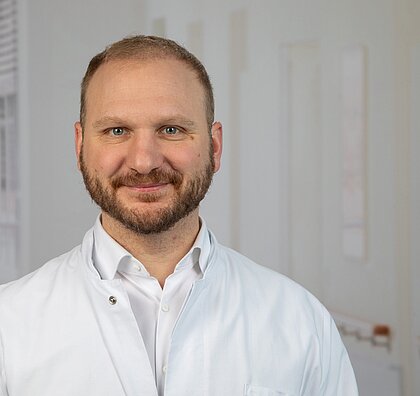
Dr. med. Thilo Gerhards
Would you like a relative to collect your findings and images? Then please use our authorization form.
Download as PDF(88 KB)
Download information sheet MRI prostate examination
Download as PDF(439 KB)